17 - 19 марта факультет экономики провел Пятую весеннюю школу по управлению рисками, финансам и страхованию.
17 марта 2016 г.
"It's all that the young can do for the old, to shock them and keep them up to date". Этой цитатой из Джорджа Бернарда Шоу специальный гость - генеральный директор ООО СК «Сбербанк страхование» Ханнес Чопра - открыл 5-ю Петербургскую Весеннюю школу по управлению рисками, страхованию и финансам 2016 г. Господин Чопра описал основные проблемы российского рынка страхования и рассказал участникам, как страхование и другие услуги могут выглядеть в будущем. "Масс-персонализация", "share-economy", "дигитализация" скоро изменят рынки, с которыми имеет дело практически любой бизнес, и эти изменения господин Чопра называет "драматическими".
Доминик Е. Беккерс, профессор Католического Университета Левена в Бельгии, предпочел называть происходящие изменения "замечательными". В первой половине основного курса первого дня Школы профессор Беккерс познакомил слушателей с методами стресс-тестирования пенсионной системы, рассказал им о количественных оценках рисков капитала и методологиях получения таких оценок для пенсионных фондов, проводимых EIOPA (European Insurance and Occupational Pension Authority).
Благодаря лекциям, участники Школы стали лучше понимать практическую сторону оценивания рисков, - процесса, с помощью которого экономисты пытаются ответить на различные вопросы, касающиеся будущего: Что происходит при различных рыночных сценариях? Как пенсионные фонды реагируют на увеличение продолжительности жизни? Как они оценивают риск, присущий тому или иному сценарию?
Вторая половина дня была посвящена расчету законных прав и раскрытию информации в коммуникации между пенсионными фондами и участвующими в пенсионных схемах лицами (инвесторами). Как и первая, эта часть была насыщенна примерами из практики EIOPA. В заключение профессор Беккер подчеркнул необходимость наличия разумной «пенсионной стратегии будущего», а также важную роль ученых, исследующих пенсионные системы.
18 марта 2016 г.
В рамках лекций «Risk Measurement: Principles and Recent Developments» 18 марта Рогер Лэвен описал основные принципы теории оценки риска. Помимо обсуждения теоретических основ, демонстрировались наглядные примеры из области страхования. Выступление профессора представляло собой мост между прикладной и теоретической частью науки, что сделало доклад крайне интересным тем, чья деятельность так или иначе связана с оценкой рисков.
В повестке выступления стоял вопрос о недостаточном применении существующих теоретических знаний в области оценки риска. В ходе доклада автор показал, насколько значимыми такие знания могут оказаться, когда речь идет о практике. Начав со знаменитого Петербургского парадокса, профессор Лэвен рассказал о законе больших чисел и его роли в теории риска.
В терминах оптимизационной задачи докладчик описал, каким образом распределение риска между экономическими агентами способствует снижению вероятности наступления неблагоприятных событий. Отдельное внимание было уделено отношению к риску со стороны агентов в тех случаях, когда речь идет о передаче риска (risk transfer). Часть выступления была посвящена неопределенности относительно рисков, вызванной невозможностью точного определения функции распределения вероятности.
Профессор Лэвен также рассказал и о подходах к измерению риска, определив классы функций, которые могут быть использованы с этой целью. Сопровождая теоретические концепции экономическими интерпретациями, лектор подробно разобрал задачу выбора оптимального портфеля в условиях неопределенности, а также проблему нахождения решения этой задачи в рамках выдвинутых предположений.
19 марта 2016 г.
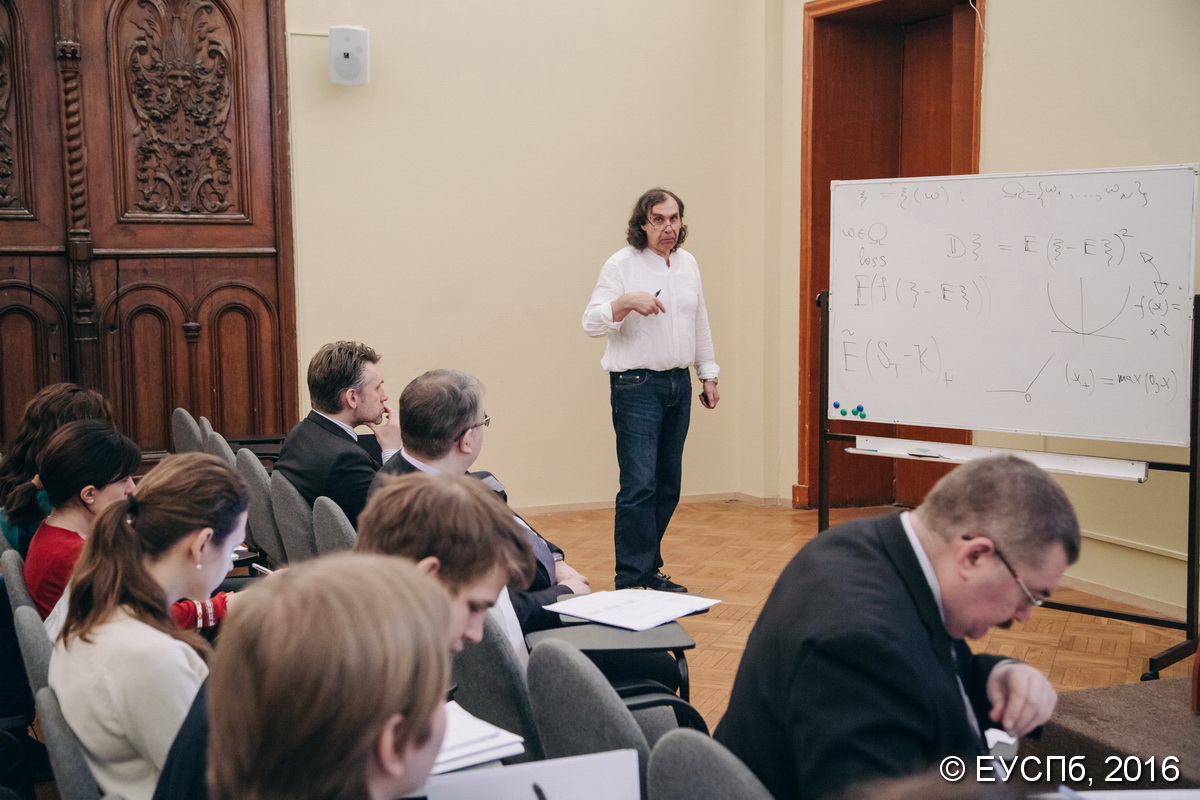
Весенняя школа по управлению рисками, страхованию и финансам завершилась выступлением Олега Витальевича Русакова, профессора Санкт-Петербургского государственного университета. Лекция была посвящена финансам, а точнее «временной зависимости в финансовых моделях». В первую очередь Олег Витальевич поднял «философские» вопросы терминологии. Обсуждались понятия меры риска, вероятности, стохастической независимости, шума – нелегкого понятия для математики. В связи с этим спикер вспомнил, как в свои юношеские годы он встречался с академиком Колмогоровым, и как тот расценивал понятие вероятности. Опираясь, поочередно то на цитаты из Уильяма Феллера, то на труды Анатолия Владимировича Скорохода, лектор убедил аудиторию в том, что определиться с сущностью базисных понятий, в конце концов, можно.
Профессор представил обширную классификацию случайных процессов, которая включила в себя двадцать одно наименование. Для построения финансовых моделей важную роль играют винеровский процесс, процесс Орнштейна-Уленбека, процесс Леви, случайное блуждание, процесс Пуассона и различные модификации этих процессов.
Распределение Пуассона часто встречается на практике. Одно из известных исторических использований этого распределения – пример о годовой оценке количества солдат прусской кавалерии, случайно погибших от лошадиных копыт.
При создании финансовой модели мы сталкиваемся с понятием модельного риска. Такой тип риска генерируется тремя главными составляющими: проблемой в данных, оценкой и использованием модели. В последней части выступления рассматривались понятия более высокого уровня, такие как функциональная предельная теорема, случайная проекция, случай негомогенности, гамма-распределенная случайная интенсивность. В завершение рассуждений были приведены несколько примеров реального анализа финансовых рынков.
Авторы: Петер Промеггер, Максим Кочемасов, Дмитрий Орлов
{gallery}news/2016/17_03{/gallery}
The Programme
 |
March 17th, 2016: Insurance day (6 hours)
Advanced Aspects of Pensions by Professor Dominique E. Beckers, The Katholieke Universiteit Leuven, Belgium |
Summary of the Course
This short course will consist of two major topics.
The first one will concern occupational pensions stress tests, quantitative assessments and risk capital methodology for Pension funds. The aim of the exercise which EIOPA — the European Insurance and Occupational Pension Authority - requested in 2015 for Pension funds of 17 member-states including Belgium, was to identify potential vulnerabilities of occupational schemes against adverse market scenarios and the increase in life expectancy. Along with an introduction on risk capital methodology, an insight will be given during this session into the practical experiences which were encountered by those who participated in this exercise. Furthermore the results globally for Europe and all participants, published end of January 2016, will be commented on. But the main focus in this presentation is to show the quantitative yet simplified technique in practice and the overall context to be taken in to account. Conceptually the link with the holistic balance sheet principles underlying the new future proposed risk-based prudential regime, will be put forward. However these principles have been severely criticized by many stakeholders over time, but we could see in class if this criticism is really justified?
The second part of the course will be about calculation of vested rights and the disclosure in the pension communication to the plan participant. EIOPA has published very recently a Consultation Paper on Good Practices on Communication Tools and Channels for communicating to occupational pension scheme members. The important concepts of Pension Communication will be introduced with a specific focus on vested social rights - in opposite to funding techniques - into the Pension Communication. There are surely learning points in this context, illustrated by the intentions of EIOPA. As an illustration, we introduce on an general basis possible actuarial calculation principles for vested rights in DB and DC schemes and show their relevancy for a good pension benefit statement.
More detail and reading links are here (pdf).
Contents
I. Occupational pensions stress tests, quantitative assessments and risk capital methodology for Pension funds
1.1 The Pension risk challenge and risk identification
1.2 Governance is key in each pension risk management system
1.3 The quantification issue and the limits for risk taking
1.4 Risk capital methodology
1.5 Stress testing & scenario analysis for use in solvency testing and regulatory purposes
1.6 Introduction to the holistic balance sheet
1.7 Criticism on the holistic balance sheet
II. Calculation of vested rights and the disclosure in the pension communication to the plan participant
2.1 The pension communication paradox
2.2 Communication properties and the integration issue
2.3 Good practices on information provision (for DC schemes)
2.4 Further aspects of the integration issue and digitalisation
2.5 Social regulation & vested rights as a cornerstone for pension communication
2.6 A numerical example of actuarial calculation for vesting rights in DB & DC schemes
2.7 Pension benefit statements and digitalisation capabilities
 |
March 18th, 2016: Risk Management day (6 hours)
Risk Measurement: Principles and Recent Developments by Professor Roger J.A. Laeven, University of Amsterdam, the Netherlands |
Summary of the Course
Starting with the St. Petersburg paradox of Daniel Bernoulli, almost 300 years later the theory of risk measurement has developed into one of the most advanced and fascinating areas of actuarial science, insurance and finance. This short course will cover basic principles and recent developments in the theory of risk measurement and will discuss applications to portfolio choice, pricing and risk sharing. Special attention will be paid to the microeconomic foundations of actuarial and financial risk measurement. More detail and reading links are here (pdf).
Contents
1. Introduction
I. Basic Principles
2. Law of Large Numbers
3. Risk Pooling and Risk Spreading
II. From Basic Principles to Recent Developments
4. Measures of Risk
4.1 Risk Aversion
4.2 Ambiguity Aversion
5. Dynamic Risk Measurement
6. Optimal Portfolio Choice and Indifference Valuation
7. Optimal Risk Sharing
 |
March 19th, 2016: Finance day (6 hours)
Temporal Dependence in Financial Models by Professor Oleg Rusakov, St. Petersburg State University, Russia |
Summary of the Course
Constructing an adequate model for description of time behaviour of various quantities is a very important problem in economics and finance. In particular, in order to build a viable forecast of a quantity one needs firstly to establish a set of estimation formulae that take into account the dynamics of the corresponding quantity.
In the first part of this short course we consider deterministic and stochastic models of interest rates, discuss the effect that Poissonian flows have on bond pricing, examine a concept of a «residual dependence» for financial instruments. In this connection we also study a number of generalisations of the classical Vasicek model, constructing a class of random processes of an Ornstein-Uhlenbeck type.
In the second part of the course we discuss a construction of a geometric Brownian motion process as a limiting case for a binary process. We apply this model in a non-traditional way: our aim is to obtain objective and well-grounded in mathematical principles estimations of rational prices in the real estate market. We shall also see a new role for the Sharpe ratio, which it plays in a process of sequential comparisons of various quantities.
Contents
1. Introduction. Deterministic models
I. Basic Stochasics Principles
2. Laws of Large Numbers, absence of after-effects, characterisations of distributions
3. Subordinations (random changes of time) for random processes
4. Poissonian and pseudo-Poissonian processes
5. The Ornstein-Uhlenbeck process and its characterisation properties
6. Multi-agent model for the Ornstein-Uhlenbeck type processes
7. Case of random intensity of the leading Poisson process
8. The O.Vasicek model and its generalisations. Numerical examples
9. Random contraction or random projection? How AR(1) model underestimates risks which follow from the past
II. Geometric Brownian Motion (gBm) and Log Normal distribution
10. A binary scheme and the Cox-Ross-Rubinstein model
11. Limit transition from the Cox-Ross-Rubinstein model to the Black-Scholes model: the functional limit theorem gives convergence of continuous functionals of prices
12. Binary process of sequential comparisons of values and gBm as a limit
13. The initial value choice problem and the Sharpe ratio in this relation
14. Applications to the real estate market and examples
|
The Organising Committee
|
Contact Ms Lina Korotkova Department of Economics E-mail: lkorotkova@eu.spb.ru Phone/fax: +7 (812) 386-7632 |