Search by section

SUBSTANCE IS SUBJECT

14.11.2018
Hegel famously maintained that no philosophy can be summed up in a single proposition or a first principle. As he said in the Phenomenology of Spirit: “Any so-called basic proposition or principle of philosophy, if true, is also false, just because it is only a principle.” Its truth can only lie in its development, its deployment, ultimately in a system, not in the assessment of some foundational proposition.
photos video

HOW COLLABORATIVE, BOTTOM-UP APPROACHES CAN PRODUCE EFFECTIVE HEALTH INTERVENTIONS — Medical Anthropology and the Case of HIV Prevention in Ukraine

13.11.2018
Ukraine continues to face one of the worst HIV epidemics in Europe. To date, prevention efforts there have largely consisted of information dissemination and needle/syringe exchange and distribution. In an effort to introduce new, culturally relevant and effective prevention strategies into Ukraine, a team of medical anthropologists and sociologists from the U.S. and Ukraine worked with local HIV activists in Ukraine to create and pilot novel, bottom-up interventions for drug users based on U.S. behavior change theories.

CLEAN ENERGY Forum

13.11.2018
On November 29, 2018, the Research Center ENERPO of the European University at Saint-Petersburg will welcome the third International CLEAN ENERGY Forum. The Forum will give room to discussions on clean energy and climate change: risks, strategies and possibilities.
video

THE ETHNIC REGIONS AND ELECTORAL SUPPORT FOR THE INCUMBENT: The Politics of Federal Transfers in Russia from 2000 to 2012

26.09.2018
How do incumbents in electoral authoritarian regimes manage to secure extraordinarily high levels of their electoral support? This study examines the determinants of the allocation of federal transfers to regional budgets in Russia to test whether the interbudgetary payments are used as a politically neutral tool with welfare equalizing goals or pursue various political aims of self-interested actors.

CHINA'S CLIMATE-ENERGY POLICY: IMPACTS ON CIS COUNTRIES, MONGOLIA, AND RUSSIA

24.09.2018
China has rapidly evolved energy and climate change policies to meet several goals of energy security, air pollution control, industrial development, and carbon emissions reduction. This has significant economic, social and environmental impacts domestically and internationally. This talk focuses on the CIS countries and Mongolia (and possibly Russia) to explore these impacts and to discuss further implications.

MARIA TROFIMOVA SPEAKS ON ACADEMIC FREEDOM IN EUROPE

21.09.2018
On Wednesday, September 12, 2018, Dean of EUSP International Programs Maria Trofimova presented her views on the topic of Academic Freedom in Europe at EAIE conference in Geneva. She discussed an important distinction between academic freedom and institutional autonomy, threats to academic freedom from outside and from within academia, and importance of international academic solidarity.

375 DAYS WITHOUT A LICENSE

13.08.2018
On August 10, 2018, Rosobrnadzor, the Federal Service for Supervision in Education and Science, finally issued its order No. 1140, granting a new teaching license to the European University at St. Petersburg (EUSP). The University was granted the right to implement all graduate and postgraduate programs for which it applied in the fields of anthropology, art history, economics, history, philosophy, political science, and sociology. EUSP’s primary concern is to re-enroll those students forced to suspend their MA studies due to the revocation of the license.

EUSP PASSES INSPECTION

01.08.2018
The on-site inspection of the European University at St. Petersburg lasted two days and ended on August 1, 2018. Rosobrnadzor experts Alexander Balashov, Dmitry Sinkov and Elena Verkhovskaya found no violations of licensing requirements. The inspection report has established the availability of

COURT HEARING NEWS, June 28, 2018

10.07.2018
On June 28, the Ninth Arbitration Court of Appeal in Moscow reviewed the EUSP appeal and ordered to leave the previous decision in force. This was the last act in our lawsuit against Rosobrnadzor.

THIRD-COUNTRY EFFECTS OF EXPORT INCENTIVES

04.06.2018
Though empirical literature on the effects of export incentives for domestic export is very rich, export incentives’ effects for third countries' export have not yet been examined empirically. This paper sheds some light on this issue. According to existing theory, effects of domestic export incentives for third countries' exporters can be both negative (due to increased competition) and positive (due to input-output linkages in global value chains (GVCs)).

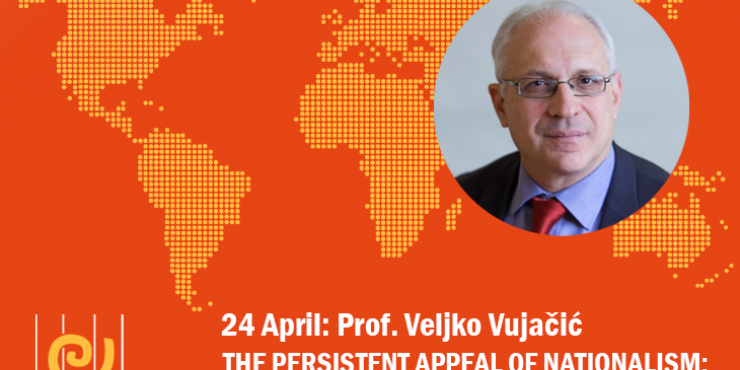
NATIONALISM AND LOVE

22.05.2018
Following on Wednesday's talk, this lecture will focus on the contribution of nationalism to the emotional repertoire of humanity. At the core of the argument will be the claim that self-realization, including its central venues and expressions such as love and happiness, was such a contribution and that these emotions, contrary to what is generally believed, are therefore functions of nationalism and uniquely modern.

GLOBALIZATION OF NATIONALISM

22.05.2018
The talk will focus on the nature of nationalism and its spread, between the 16th and the 20th centuries, within its original monotheistic civilization. This will be contrasted with the particular dynamics of the globalization of national consciousness in the last decades, as it breaks through these borders and penetrates into China and India.

CHARISMA, CAMP, OR KITSCH? GENDER PERFORMATIVITY IN PUTIN’S RUSSIA

14.05.2018
Since his rise to power in 1999, Vladimir Putin has crafted a public persona whose appeal relies on a clearly constructed larger-than-life masculinity. Perceived by some as the return of charismatic leadership to post-Soviet Russia and by others as pure camp, Putin’s masculinity functions as the cornerstone of a gender order that paradoxically seeks to naturalize the binary opposition between male and female through artifice and exaggeration.

MORE AWKWARD ECONOMICS OF HIGHER EDUCATION

14.05.2018
Higher education in the United States has seen a dramatic expansion throughout the last century. The lecture, while intended for a broad audience, will offer an overview of the US Higher Education (HE) system from an economist’s perspective. It will undertake an analysis of HE’s operation as a marketplace. I will firstly survey the main distinctive features of an American university (admission, students’ choice of specialization, funding, tuition, placement, etc.).

NATIONAL TREASURE OR QUACKERY? Changing attitudes to folk and complementary medicine in post-Soviet Kazakhstan and Kyrgyzstan

29.04.2018
In my presentation I will discuss how the official attitudes to complementary and alternative medicine (CAM), and particularly to folk healing have been changing in Kazakhstan and Kyrgyzstan since proclamation of their independence. Initially, these countries, similar to the other newly independent Central Asian states, strove to confirm their legitimacy through referring to the richness of their cultural heritage, including traditional medical knowledge and practices.

THE AAUP AND THE STRUGGLE FOR ACADEMIC RIGHTS IN THE U.S.

19.04.2018
The American Association of University Professors was founded in 1915 to defend the academic freedom and general professional standing of college and university faculty members. It is widely recognized as the authoritative voice on questions of academic freedom at all levels of higher education in the U.S. In the early 1970s the AAUP embraced trade union representation and today about 3/4 of its 50,000 members are in union chapters.

“SPANISH CASTLES” IN THE AEGEAN: Greek Political Imagination in the Russian Archipelagic Principality, 1770-1774

06.04.2018
On December 20, 1768, as Russian plans to launch a naval expedition into the eastern Mediterranean began to materialize, Catherine II wrote to her envoy in London, describing how her tendency to build “Spanish castles” had been awakened. While, in some ways, idealistic, Catherine’s Greek project produced several tangible successes in the early 1770s. Following the victory at Chesma, in the summer of 1770, the Russian navy established firm control over the Aegean Sea for the remainder of the war.